
Reviewed · EL JEM AMPHITHEATRE TOURS
Private Tour to Kairouan, El Jem & Monastir from Tunis_hammamet
Three major sites, one long day. This private tour links Kairouan’s Great Mosque, the vast Roman amphitheater at El Jem, and Monastir’s coastal Ribat in an efficient loop from Tunis or Hammamet. You also get time in Kairouan’s old medina and a stop at the historic Aghlabid water basins.
I especially like the strong mix of Islamic, Roman, and Punic-era sights, plus the convenience of hotel pickup and an air-conditioned vehicle. The guides are often praised for their warmth, language skills, and willingness to adjust the day. The catch is the distance: eight to ten hours means plenty of time in the car, and the schedule can feel brisk at the main monuments.
At $98.48 per person, the value depends partly on the size of your party. For a private group, the price covers transport, a certified guide, and five admissions, which is useful in Tunisia where arranging this route independently can take effort. I would still confirm the pickup point, lunch plan, and guide arrangements before setting off.
In This Review
- Key points to know before booking
- Why this three-city route works
- Kairouan’s Great Mosque and its fortress-like form
- Walking Kairouan’s old medina
- The Aghlabid basins and Kairouan’s water system
- Entering El Jem’s 30,000-seat amphitheater
- Monastir’s Ribat and its spiral staircase
- The guide and driver can make or break the day
- Timing, lunch, and the private format
- Is $98.48 good value?
- Who should book this experience?
- Should you book the Kairouan, El Jem, and Monastir tour?
- FAQ
- How long does the tour last?
- Where does the tour start?
- Is this a private tour?
- What is included in the price?
- Is lunch included?
- How much does the tour cost?
- Which places are visited?
- How long is each scheduled visit?
- Can service animals participate?
- Can I cancel for a full refund?
Key points to know before booking
- Kairouan gives the day its spiritual center: You visit the Great Mosque, the old medina, local souks, carpet workshops, and the famous makroud pastry.
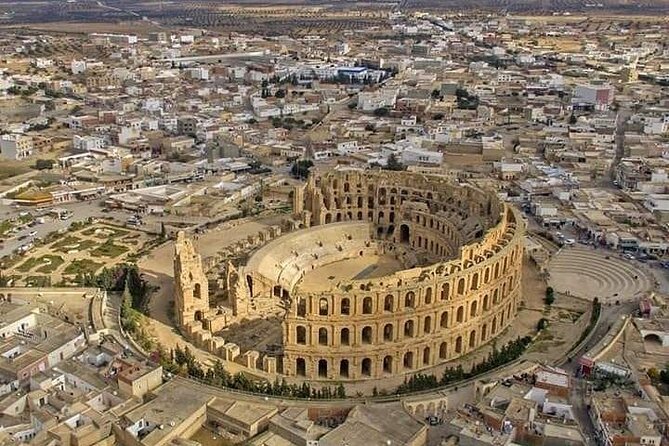
- El Jem is the visual highlight: Its third-century amphitheater could hold about 30,000 spectators and is one of the most striking Roman monuments in Africa.
- Monastir adds sea views and medieval defenses: The Ribat’s watchtower offers views over the city and coast after a climb of roughly one hundred spiral steps.
- The route covers serious ground: Expect an eight to ten-hour outing, with several stretches between stops.
- A private format can be flexible: Guides such as Yaya, Kimos, Bilel, Bilal, Ahmed, Beligh, and Chaouki have been praised for adapting the day to individual interests.
- Shopping requires care: A serious complaint involved a carpet purchase at a shop presented as official. Treat any sales stop as optional and ask for proof of authenticity before buying.
Why this three-city route works
Kairouan, El Jem, and Monastir are not neighboring attractions you can casually walk between. They form a broad route across central and eastern Tunisia. That makes a private vehicle especially useful.
The tour begins with hotel pickup in Tunis or Hammamet, then moves through religious history, Roman engineering, and coastal Islamic architecture. You are not spending the whole day in one archaeological site. Instead, each stop changes the subject and the setting.
That variety is the main reason to choose this excursion. Kairouan explains Tunisia’s place in the Islamic world. El Jem shows the wealth and reach of Roman Africa. Monastir brings the day back to the sea, where early Islamic rulers built defensive monasteries along the coast.
The cost includes an air-conditioned vehicle, a certified professional guide, GST, and admission to the Great Mosque, Kairouan medina, El Jem amphitheater, Monastir’s Ribat, and the Aghlabid basins. Lunch is not included, so keep room in your budget for the midday meal.
The private setup is valuable if you want to ask questions, slow down for photographs, or request a little more time at one site. It is less attractive if you prefer a relaxed day with long breaks. The route is ambitious, and the clock matters.
More El Jem Trips in Tunis
- Daytrip to Kairouan and El Jem Colosseum
★ 4.5 · 55 reviews - Kairouan and El Jem Private Day Tour
★ 4.5 · 38 reviews - Private Day Tour , Kairouan & Amphitheatre of el Jem From Tunis /Hammamet/Sousse
★ 4.5 · 8 reviews
Kairouan’s Great Mosque and its fortress-like form
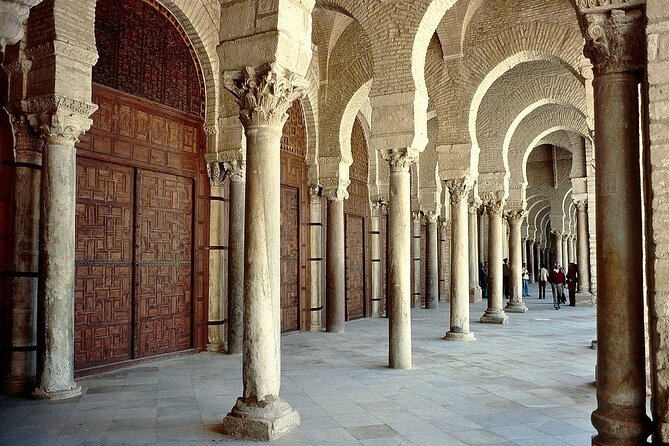
The Great Mosque is the emotional center of the excursion. Founded in 670, it is regarded as one of the oldest religious buildings in the Muslim West and helped shape mosque design across the Maghreb.
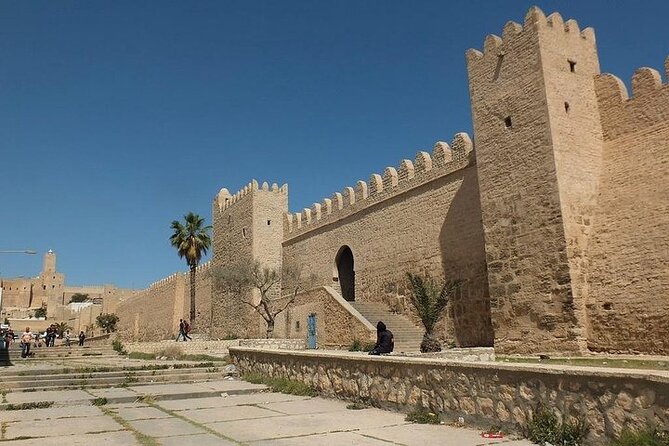
You begin with the exterior, where the massive walls give the building the look of an adobe fortress. The minaret is imposing rather than delicate, and the broad courtyard gives the complex a powerful sense of scale.
Look for the arcades around the courtyard and the sundial sheltered within them. The high cedar doors are carved with care, while the prayer rooms contain rows of marble columns. A guide adds real value here because the building’s importance is not obvious from its severe outer walls alone.
The scheduled visit lasts about 40 minutes. That is enough for an introduction and a careful look, but it is not an extended architectural study. If religious access rules or site conditions affect the visit, your guide will direct you, so modest clothing and respectful behavior are sensible.
I would use this first stop to get your bearings. Ask your guide how the mosque influenced later buildings in North Africa, and pay attention to how practical military-looking construction frames a place of worship.
Walking Kairouan’s old medina
After the mosque, you have about 30 minutes in Kairouan’s medina. This is short, but it gives you a taste of the city beyond its best-known monument.
The medina is described as one of Tunisia’s most preserved and authentic old quarters. You can look through the souks, see local craftwork, and sample makroud, the date-filled pastry associated with Kairouan. The combination of sugar, semolina, and dates makes this one of the easiest local specialties to try during a busy day.
Carpet making is another part of the visit. You might see patterns, knots, and regional styles that are difficult to understand from a shop display alone. This is also where you should stay alert about purchasing.
One poor experience involved a carpet shop where the buyer was told the store was an official government outlet. The carpet was later judged to be fake by an expert. The tour company responded that the guide involved was an independent guide registered with Tunisia’s national tourism office, not a company employee.
That explanation does not erase the warning. You do not have to buy anything to enjoy Kairouan. If you are interested in a carpet, ask about its material, origin, knot count, written invoice, return terms, and independent certification. Take your time. A private tour should give you room to say no.
The Aghlabid basins and Kairouan’s water system
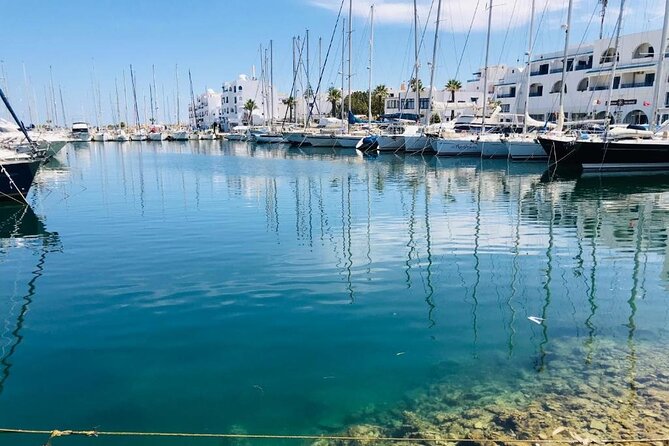
The Aghlabid basins are a quick but worthwhile addition to the Kairouan section. Dating from the beginning of the second half of the ninth century, these large reservoirs were built outside the medina walls.
Their importance is practical. Kairouan needed a dependable water supply, and the basins formed part of an ambitious hydraulic system. The site helps you picture the city not only as a religious center, but also as a place that required serious public works to support its population.
The planned stop is about 20 minutes. Do not expect a long museum visit or a crowded attraction filled with displays. This is an outdoor historical pause, best understood with a guide’s explanation of how the reservoirs fit into the city’s development.
Because the basins are visited on the same day as the mosque and medina, they complete the Kairouan story nicely. You see faith, commerce, craft, and infrastructure in one morning.
More Kairouan & Dougga Trips in Tunis
- Private Excursion to Testour, Dougga and Bulla Regia from Tunis.
★ 5.0 · 100 reviews - Full Day Dougga & Bulla Regia Via Testour Private tour with Lunch
★ 5.0 · 29 reviews - Private Guided Tour of Dougga and Testour Mosque
★ 4.5 · 15 reviews - Dougga and Bulla Regia Guided Tour From Tunis
★ 4.5 · 11 reviews
Entering El Jem’s 30,000-seat amphitheater
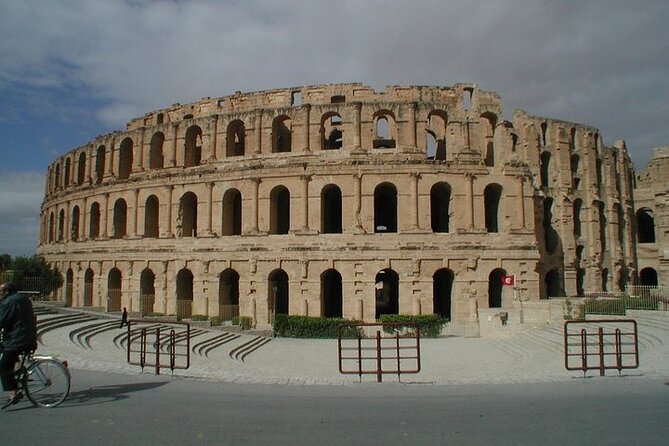
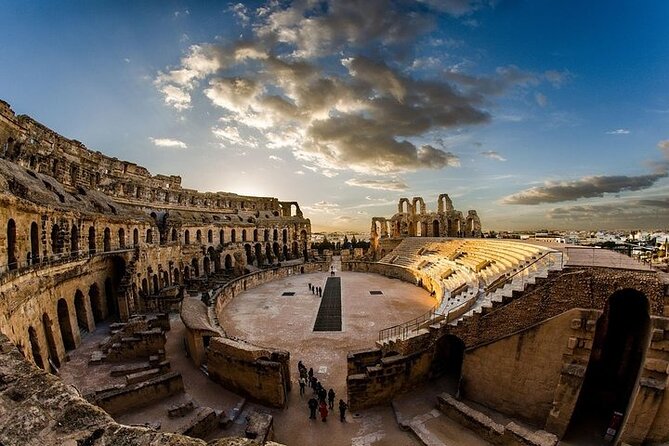
El Jem is the reason many people choose this tour. The amphitheater was founded in the third century AD in the ancient city of Thysdrus, one of the prosperous centers of Roman Africa.
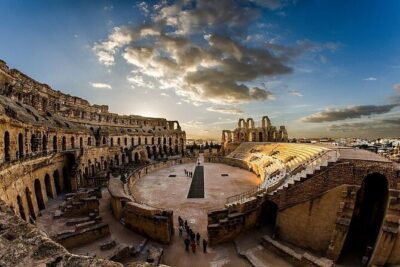
Its scale is startling. It could accommodate about 30,000 spectators and ranks as the third-largest Roman amphitheater after Rome’s Colosseum and the amphitheater at Capua. It is also a UNESCO World Heritage Site, classified in 1972.
The 40-minute visit lets you see the arena, exterior arches, upper levels, and underground structures. One useful point from the guide commentary is that El Jem can feel smaller than Rome’s Colosseum from outside, yet its underground areas are unusually extensive. That makes the lower levels especially worth your attention.
I would not rush this stop. The amphitheater is the place where a few quiet minutes can be more rewarding than constant explanation. Look down into the service areas below the arena, then climb for a wider view of the structure and surrounding town.
The main limitation is time. Forty minutes is enough to understand the monument, but you may want longer if Roman architecture is a major interest. If El Jem is your priority, tell the guide early in the day. Several guides, including Ahmed and Caulios, have been praised for clear historical explanations and helpful pacing.
Monastir’s Ribat and its spiral staircase
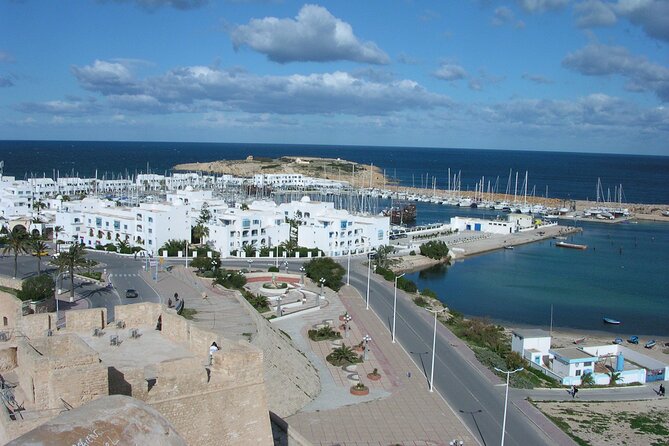
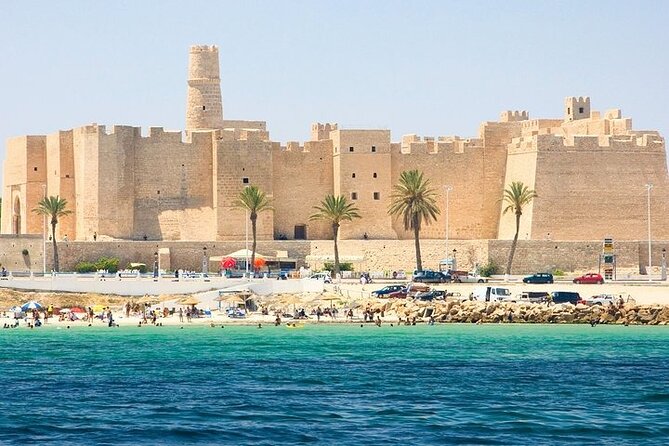
The final major monument is the Ribat of Monastir, founded in 796. It was one of the key defensive buildings raised along the Maghreb coast during the early Islamic period.
The complex began as a quadrilateral with four main buildings and two inner courtyards. Its small cells housed warrior monks who combined military duties with prayer and contemplation. Two prayer rooms are also part of the structure, and one now contains collections connected with medieval worship and crafts.
The visit lasts about 40 minutes. The most memorable feature may be the watchtower, reached by around one hundred spiral steps. From the top, you get a view over Monastir and the sea, along with the wider defensive purpose of the building.
The climb is not ideal for everyone. The tour information says most people can participate, but it does not promise that every part of the Ribat will suit every level of mobility. If stairs are a concern, ask your guide what can be seen without climbing.
Monastir also gives the itinerary a satisfying change of mood. After Kairouan’s inland religious monuments and El Jem’s arena, the Ribat brings you to a coastal city shaped by defense, faith, and maritime communication. Its towers once exchanged luminous signals with neighboring ribats at night.
The guide and driver can make or break the day
This route places unusual demands on the people leading it. You spend hours on the road, then need clear explanations at five separate stops. A careful driver matters just as much as an engaging guide.
Many guides are praised by name. Yaya is described as caring, intelligent, and entertaining. Kimos is credited with making a solo visitor feel comfortable, even joining the person for lunch so they would not dine alone. Bilel and Bilal receive praise for good organization and strong knowledge of Tunisian history and culture.
Other positive reports highlight Ahmed, Beligh, Balagh, Chaouki, and Caulios. The repeated strengths are punctual hotel pickup, friendly service, good language ability, and a willingness to adapt. One guide reportedly made sure a group saw everything possible even when one location closed earlier than expected.
A multilingual guide can be particularly helpful if your group includes people with different language needs. One person specifically praised a guide who spoke several languages fluently.
There are also two practical cautions. One account describes a flat tire on the highway and says the tire appeared worn before departure. The company replied that vehicles are checked and that safety is a priority. A separate account praised the driver’s care and said driving skill mattered because of the long hours in the vehicle.
I would confirm the vehicle and pickup details the day before. If you have a long drive ahead, a well-maintained car, sensible driving, and clear communication are not minor comforts. They shape the whole day.
Timing, lunch, and the private format
The tour runs approximately eight to ten hours. That includes five visits, road time, hotel pickup and return, and a lunch break that you pay for separately.
The schedule is efficient rather than slow. You get roughly 40 minutes at the Great Mosque, 30 minutes in the medina, 40 minutes at El Jem, 40 minutes at the Ribat, and 20 minutes at the Aghlabid basins. Driving between these places fills the gaps.
Bring water, comfortable shoes, sun protection, and a phone or camera. The information does not specify a restaurant or fixed lunch menu, so ask your guide where the meal will happen and what kind of stop is planned. If you have dietary needs, raise them before departure.
This is listed as a private tour, meaning only your group participates. That gives you more control than a large coach excursion. One account describes choosing an option with a guide included and appreciating the freedom to discuss preferences during the day.
There is one contradictory detail in the supplied experiences: one person described joining an actual group tour. Because tour options can vary, confirm that your selected booking is private if that matters to you.
Is $98.48 good value?
At $98.48 per person, I see solid value for a small private group that wants to cover all three destinations in one day. Admissions are included, as are the guide, vehicle, and tax. You are paying for convenience as much as for sightseeing.
The value is strongest for people staying in Tunis or Hammamet who do not want to arrange intercity transport, find each monument, manage opening times, and negotiate local logistics. A private driver also removes the pressure of navigating an unfamiliar route.
The price is less compelling if you dislike long road days or want extensive time at each monument. You are covering a lot of ground, and lunch is extra. A slower itinerary with an overnight stay would give you more time, but this tour is designed for efficient sightseeing.
Group discounts are offered, although no discount amounts are provided. Ask about the final per-person price for your party before booking. For couples, the total cost may feel higher than a shared excursion. For three or more people, private transport and a guide can become a more sensible deal.
Who should book this experience?
I would recommend it to first-time visitors who want a broad introduction to central and eastern Tunisia. It works well for people staying in Hammamet or Tunis, especially if their schedule does not allow separate trips to Kairouan, El Jem, and Monastir.
It also suits families and small groups who value hotel pickup and the ability to ask for adjustments. Older visitors have described feeling safe and comfortable, while solo visitors may appreciate the personal attention of a private guide.
I would hesitate if you want a relaxed cultural day with long café breaks. The itinerary is full, and the road time is real. I would also be cautious about buying expensive carpets during the medina visit unless you already understand Tunisian carpet quality and have a way to verify a purchase.
Free cancellation is available up to 24 hours before the start time for a full refund. Changes made inside that period are not accepted, and poor weather can lead to a different date or a full refund.
Should you book the Kairouan, El Jem, and Monastir tour?
Yes, if you want three major Tunisian sights in one organized day and accept the long hours on the road. El Jem is the clear highlight, while Kairouan gives the tour its strongest cultural and religious focus. Monastir rounds things out with a coastal fortress and a fine city view.
Before paying, confirm four things: your exact pickup location, whether your option is truly private, who your guide will be, and how lunch will be handled. I would also make it clear that shopping is not a required part of the day.
Choose this tour for convenience, variety, and access to places that are awkward to combine by yourself. Skip it if you prefer slow travel or want to study one site at length. For an ambitious first look at Tunisia beyond the resort towns, it is a practical and worthwhile choice.
FAQ
How long does the tour last?
The experience lasts approximately eight to ten hours.
Where does the tour start?
Pickup is offered from hotels in the Tunis or Hammamet area, according to the tour title and supplied details.
Is this a private tour?
Yes. The activity is described as private, with only your group participating. One supplied account refers to a group option, so confirm the exact option you select when booking.
What is included in the price?
The price includes GST, a certified professional tourist guide, an air-conditioned vehicle, and admission to the Great Mosque of Kairouan, Kairouan medina, El Jem amphitheater, Monastir’s Ribat, and the Aghlabid basins.
Is lunch included?
No. Lunch is not included in the price.
How much does the tour cost?
The listed price is $98.48 per person. Group discounts are offered, but the discount amount is not specified.
Which places are visited?
The itinerary includes the Great Mosque of Kairouan, Kairouan medina, the Aghlabid basins, El Jem amphitheater, and the Ribat of Monastir.
How long is each scheduled visit?
The Great Mosque visit is about 40 minutes, the medina visit about 30 minutes, El Jem about 40 minutes, the Ribat about 40 minutes, and the Aghlabid basins about 20 minutes.
Can service animals participate?
Yes. Service animals are allowed.
Can I cancel for a full refund?
Yes, if you cancel at least 24 hours before the experience start time. Cancellations made less than 24 hours before the start time are not refunded. If poor weather causes the operator to cancel, you will be offered another date or a full refund.
More Kairouan & Dougga Trips in Tunis
- Roman Archeology Guided Tour Thuburbo Majus & Uthina
★ 4.5 · 7 reviews - Daytrip 3 Unesco Sites El Jem Kairouan and Sousse Medina
★ 5.0 · 7 reviews - Full-Day Kairouan and El Jem Tour from Tunis
★ 4.0 · 7 reviews - Kairouan & El Jem Small Group Tour from Tunis, Hammamet or Sousse
★ 5.0 · 6 reviews
More Private Tours in Tunis
- Private tour: Medina,Carthage ,Sidi Bou Said, Bardo Museum+lunch
★ 5.0 · 230 reviews - Carthage, Bardo Museum, Sidi Bou Said and Medina Private Day Tour
★ 4.5 · 153 reviews - Private Day Tour Tunis Medina Carthage Sidi Bou Said Bardo Museum
★ 5.0 · 30 reviews - Private 3 Day Tour in Southern Tunisia or More
★ 5.0 · 17 reviews
Newest from Tunis
- Private Arrival Transfer: Tunis Airport to Tunis Hotel★ 4.5 · 5 reviews
- Cap Bon Guided Day Tour from Tunis★ 5.0 · 2 reviews
- Tunis Group Tour: Carthage, Sidi Bou Said, Bardo museum & Medina★ 5.0 · 5 reviews
- Walking City Tour★ 4.5 · 7 reviews
- Dougga Guided Day Tour from Tunis★ 5.0 · 5 reviews
- Tunisia 7-Day tour★ 5.0 · 6 reviews
- Unveiling the Beauty of Sidi Bou Said and Carthage Private Tour★ 5.0 · 2 reviews
- Bardo Museum , Oudhna and the roman aqueduct★ 5.0 · 4 reviews
El Jem Amphitheatre Tours, compared.
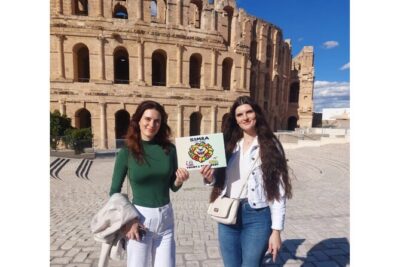
Fun VIP Tour: El Jem, Kairouan, Monastir/Sousse (PICKUP ALL City)
Read our review →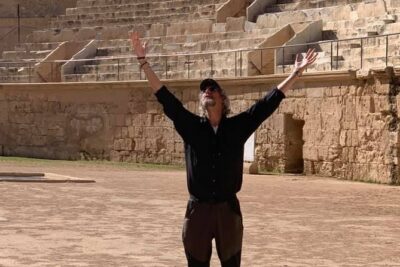
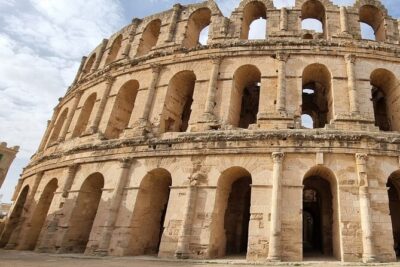
Half-day excursion from Sousse to the amphitheater of El Jem
Read our review →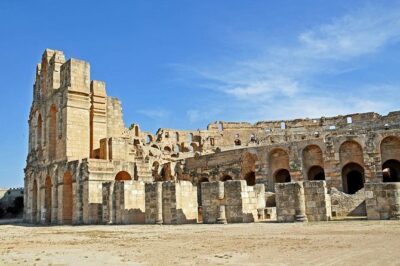
Private and Guided Tour to Kairouan and El Jem and Monastir
Read our review →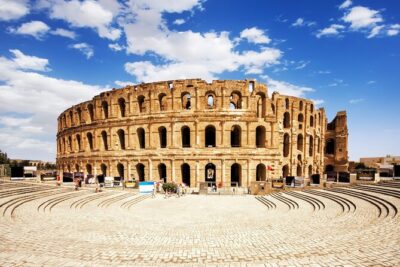
Private Half Day Tour to Roman Coliseum EL JEM from Monastir
Read our review →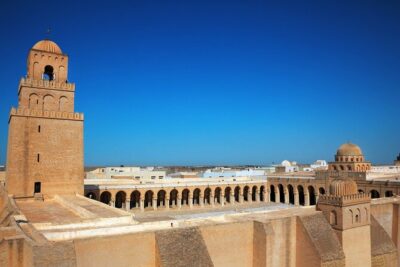
Kairouan Holy City and El Jem Colosseum Tour from Sousse
Read our review →Browse the lists this tour appears in